
FAQ
AI Server PCBA & Cable Assembly: High-Speed Manufacturing Challenges
AI Server PCBA & Cable Assembly: High-Speed Manufacturing Challenges
Technical Summary
AI server and high-speed computing applications may involve dense multilayer PCBs, controlled-impedance routing, complex interconnects, cable assemblies, higher power density and stricter reliability requirements. Compared with general electronic products, these conditions increase the importance of signal integrity, thermal control, cable routing, connector stability and manufacturing consistency.
DMAX supports PCB, PCBA and cable assembly projects according to customer-approved designs and manufacturing specifications. Depending on the project scope, DMAX may support multilayer PCB production, blind and buried microvias, controlled impedance requirements, PCBA assembly, applicable inspection and cable assembly integration.
Project-specific data rates, cable tolerances, connector performance, thermal requirements, reliability criteria and high-speed validation methods must be defined and agreed before production. Advanced signal integrity simulation, VNA / TDR validation and EMI certification are typically performed by the customer’s engineering team or a qualified third-party laboratory unless otherwise agreed.
Key Takeaways for Buyers and Engineering Teams
- AI server PCBA projects require more than standard PCB assembly because signal integrity, connector quality, cable routing, thermal stress and long-term reliability must be reviewed together.
- High-speed risks such as insertion loss, return loss, signal skew, crosstalk, shielding and grounding should be reviewed before moving from prototype to mass production.
- DMAX supports EMS manufacturing, PCBA assembly, cable assembly, inspection planning and NPI documentation review based on customer-approved specifications.
Why AI Server Platforms Create More Manufacturing Risk
AI server platforms are designed to process large volumes of data at high speed. Compared with general industrial electronics, they often involve high-speed interfaces, dense component placement, advanced connectors, multiple cable assemblies, high power density and strict reliability requirements.
This means the manufacturing process must do more than simply assemble parts correctly. Even when a PCBA passes basic visual inspection, the system may still face performance or reliability issues if signal paths, connector transitions, cable routing, shielding, grounding, thermal behavior or mechanical stress are not properly reviewed before production.
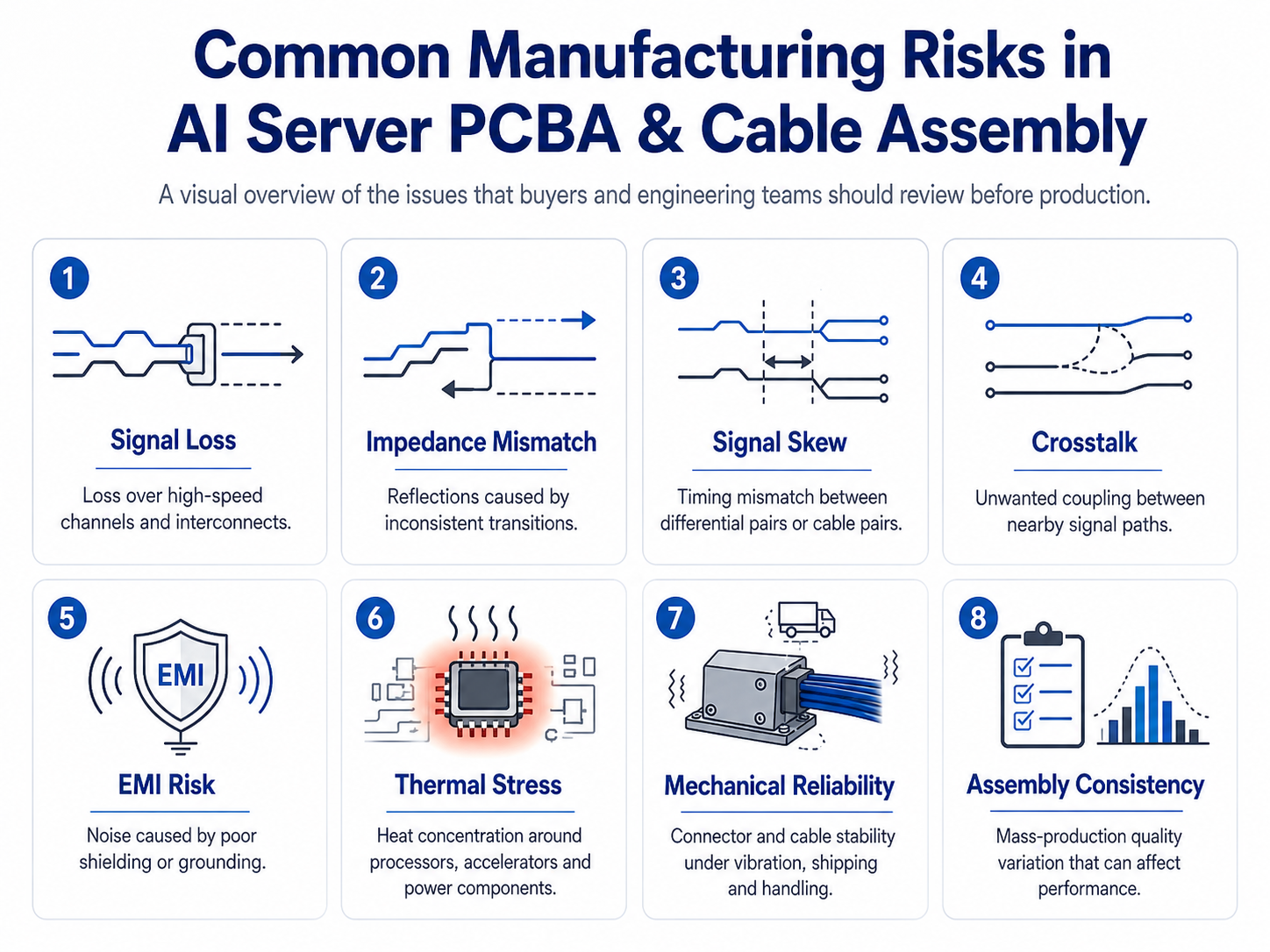
Common Manufacturing Risks in AI Server PCBA and Cable Assembly
- Signal loss over long or complex high-speed channels
- Impedance mismatch at PCB, connector or cable transitions
- Timing mismatch between differential pairs or cable pairs
- Crosstalk between nearby routing or interconnects
- EMI risk caused by poor shielding or grounding continuity
- Thermal stress around processors, accelerators or power components
- Mechanical reliability issues during vibration, shipping or handling
- Assembly consistency variation during mass production
These risks are often connected. For example, a cable routing issue may affect crosstalk, EMI and mechanical reliability at the same time. A connector assembly issue may influence insertion loss, return loss and long-term contact stability.
For high-density board requirements, product categories such as HDI (High Density Interconnect) PCBs and Multilayer Rigid PCBs may be relevant depending on the customer’s design. For space-constrained or mechanically complex structures, Rigid-Flex PCB Assembly may also be reviewed during early manufacturing discussion.
Manufacturing Responsibility Note: DMAX manufactures according to customer-approved designs and specifications. High-speed signal integrity targets, simulation methods, interface compliance requirements and validation criteria should be defined by the customer’s engineering team or qualified laboratory before production.
DMAX PCB Manufacturing Capability Notes
DMAX may support multilayer PCB production, blind and buried microvias, controlled impedance requirements and selected PCB material options according to customer-approved specifications.
Available material options may include FR-4, high-Tg FR-4 and other project-specific PCB materials, subject to approved project requirements, material availability and customer specifications. Specific capabilities such as maximum layer count, minimum drill size, impedance tolerance and material availability should be confirmed during quotation and NPI.
When This Topic Matters Most
This topic is especially relevant when a project involves high-speed signals, dense PCB layouts, multiple connectors, cable assemblies or strict reliability requirements. It is particularly useful for:
- PCBs, PCBAs, cable assemblies and interconnects used in AI server and high-speed computing applications
- High-speed IPC systems
- Industrial control systems with high-speed interfaces
- Board-to-board or cable-to-board interconnects
- Dense BGA or fine-pitch assembly areas
- HDI or multilayer PCB structures
- Shielded or high-speed cable assemblies
- Projects moving from prototype to mass production
This topic may be less critical for low-speed, simple, short-distance or non-impedance-sensitive products. In those cases, standard PCBA assembly controls may be sufficient, depending on product requirements.
Signal Integrity Risks in High-Speed PCBA Architecture
Signal integrity is one of the most important concerns in AI server PCBA and high-speed cable assembly applications. As data rates increase, the system becomes more sensitive to PCB material selection, stack-up, trace geometry, impedance control, connector quality, cable construction and assembly workmanship.
For an EMS partner, signal integrity is not only a design topic. Manufacturing and assembly quality can affect whether the built product follows the customer’s intended signal path. Connector placement, soldering quality, press-fit process control, cable routing, cable preparation and handling control all matter when the product moves from prototype to mass production.
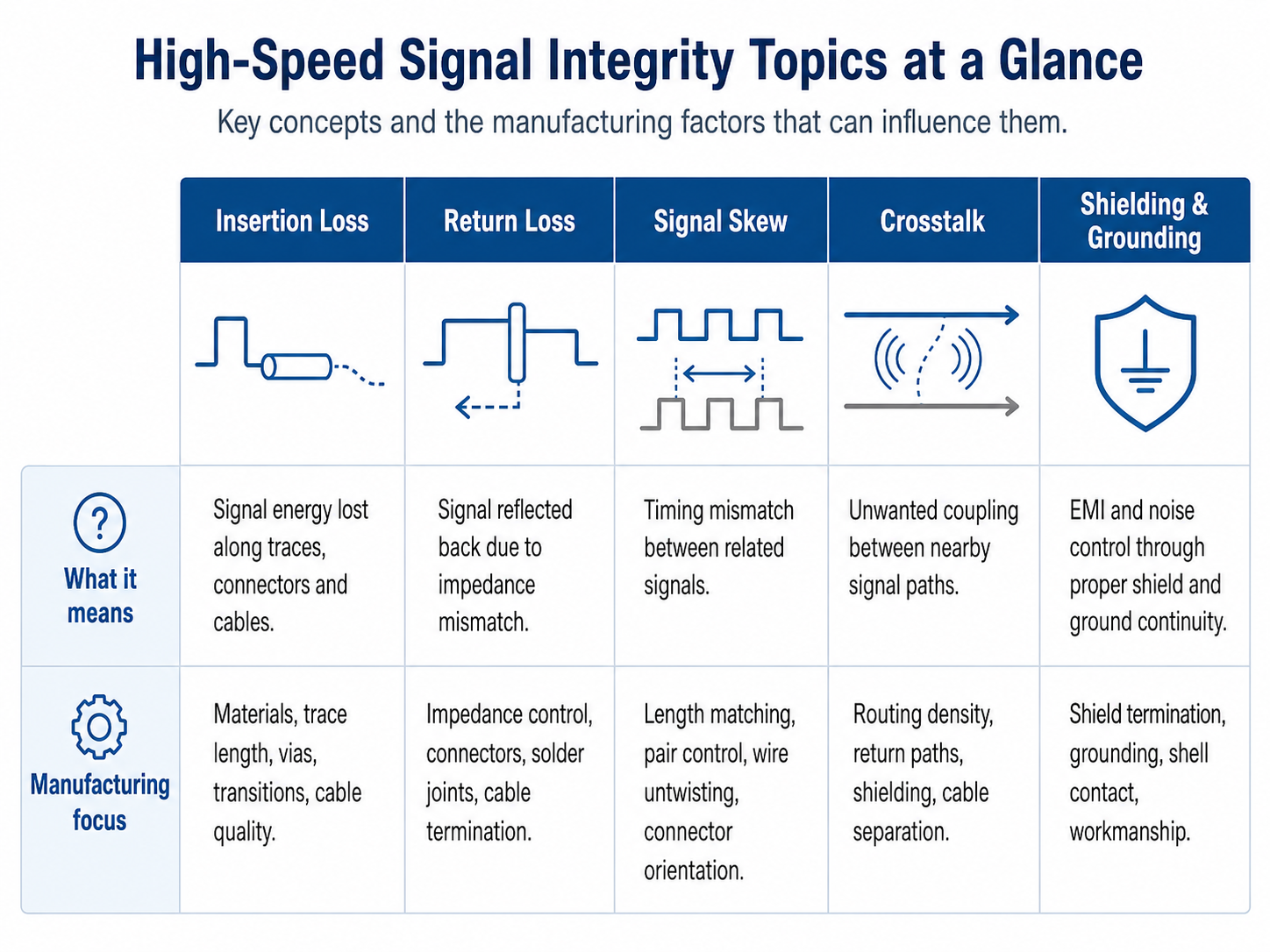
| Signal Integrity Topic | What It Means | Related Manufacturing Focus |
|---|---|---|
| Insertion Loss | Signal energy lost while traveling through PCB traces, connectors and cable assemblies. | PCB material, trace length, via stubs, connector transitions, cable length and cable construction. |
| Return Loss | Reflected signal energy caused by impedance mismatch in a high-speed channel. | Controlled impedance, via transitions, connector seating, BGA solder quality and cable termination. |
| Signal Skew | Timing mismatch between related signals that should arrive at the same time. | Differential pair matching, cable pair control, wire untwisting, connector orientation and press-fit consistency. |
| Crosstalk | Unwanted coupling between nearby signal paths. | Routing density, return path control, shielding, grounding and cable separation. |
| Shielding and Grounding | Methods used to reduce EMI, noise coupling and unwanted interference. | Shield termination, grounding continuity, cable routing, connector shell contact and workmanship control. |
Key Signal Integrity Topics for AI Server PCBA Projects
- Insertion Loss and Signal Attenuation: signal energy lost over PCB traces, connectors and cable assemblies. Related article: What Causes Insertion Loss in High-Speed PCBA & Cable Assembly?
- Return Loss and Impedance Continuity: reflected signal energy caused by impedance mismatch. Related article: Why Return Loss Matters in AI Server PCBA & Cable Assembly
- Signal Skew: timing mismatch between differential pairs or cable pairs. Related article: What Is Signal Skew in High-Speed PCBA & Cable Assembly?
- Crosstalk: unwanted coupling between nearby signal paths, especially in dense interconnect areas.
- Shielding and Grounding: essential for EMI control, noise suppression and stable cable performance.
For high-speed cable-related applications, USB 3.2 Active Extension Cables, USB AOC and USB Type-C Cables may serve as relevant product references when cable length, connector termination and signal transmission requirements need to be reviewed.
Cable Assembly and Interconnect Challenges
AI server platforms often rely on multiple cable assemblies and interconnects to connect boards, modules, power systems, storage devices, fans or high-speed signal paths. In these systems, cable assembly is not only a mechanical connection. It can become part of the signal path and may influence performance, EMI behavior and long-term reliability.
Cable Assembly Factors Buyers Should Review
- Cable length consistency
- Pair control for differential signals
- Shielding coverage and grounding continuity
- Connector termination quality
- Crimping or soldering workmanship
- Bend radius and routing control
- Strain relief and mechanical protection
- Inspection and test requirements
When required by the application, cable and wire harness assembly quality may be reviewed according to IPC/WHMA-A-620 requirements, including workmanship criteria for crimped, mechanically secured and soldered interconnections.
Thermal Stress and High-Power PCBA Challenges
AI server platforms usually require high computing power, which also means higher power density and more heat. Thermal stress can affect PCBA reliability, solder joint life, connector stability, cable insulation and nearby components.
- Heat concentration around processors, accelerators or power components
- PCB warpage during assembly or operation
- Solder joint fatigue caused by temperature cycling
- Cable insulation aging under high-temperature environments
- Connector performance changes caused by heat exposure
- Airflow restrictions caused by cable routing or dense mechanical structure
Vibration and Mechanical Reliability
Although servers are not always exposed to extreme vibration, mechanical reliability still matters because connectors, cable assemblies and solder joints may experience stress during shipping, installation, fan operation or system maintenance.
- Connector loosening
- Cable movement and abrasion
- Solder joint fatigue
- Wire or terminal damage
- Intermittent electrical contact
- Poor strain relief around board-mounted connectors
Manufacturing Information DMAX May Confirm During NPI
During NPI, DMAX can help review whether the manufacturing information provided for a high-speed PCBA or cable assembly project is clear enough for production planning. This review does not replace customer design verification, signal integrity validation or compliance testing. Instead, it helps reduce manufacturing misunderstanding before prototype build, pilot run or mass production.
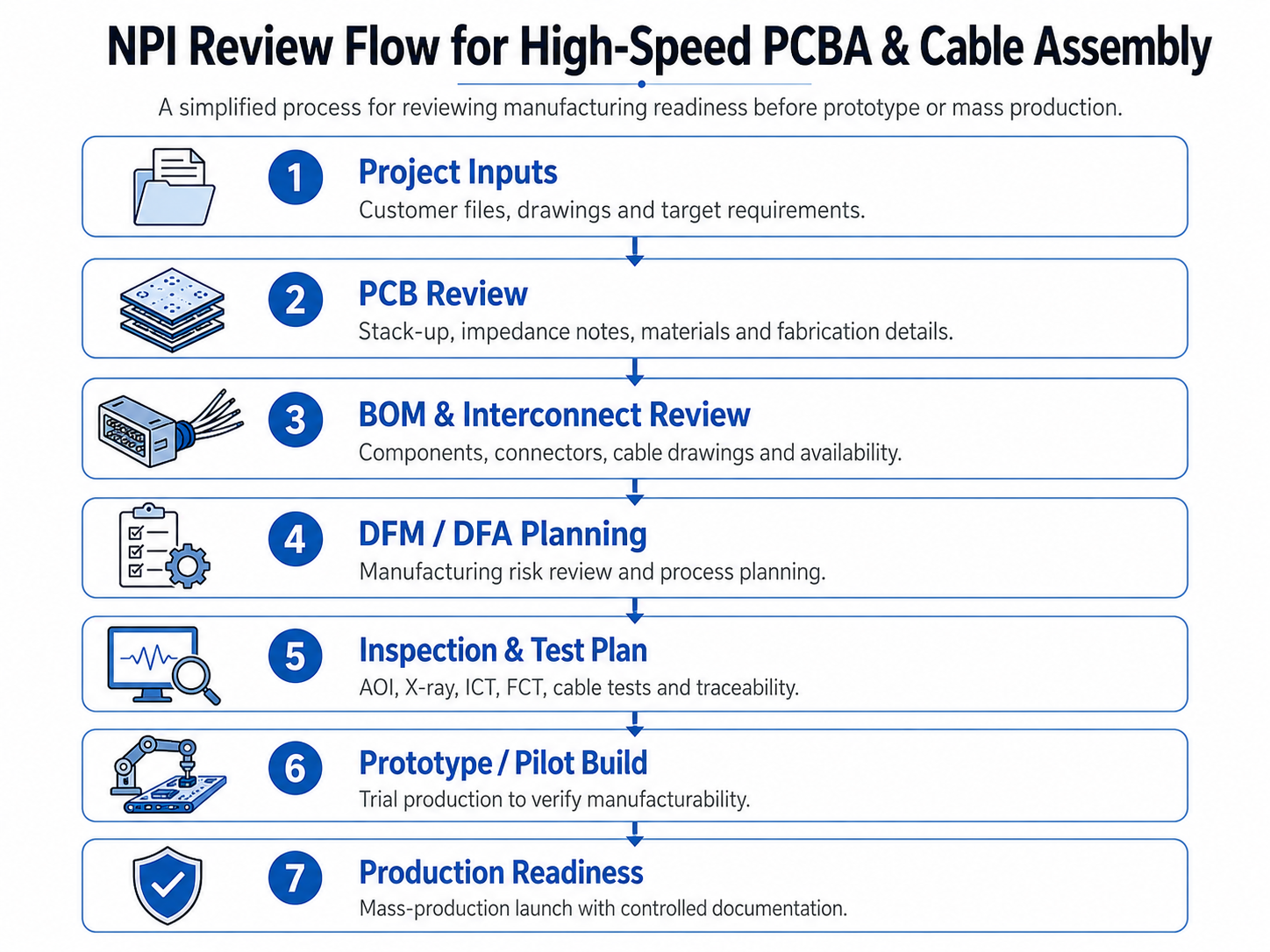
NPI Review Items for High-Speed PCBA and Cable Assembly
- PCB fabrication notes
- Stack-up and impedance notes
- Material requirements
- Connector specifications
- Cable assembly drawings
- Cable length and routing requirements
- Shielding and grounding requirements
- BOM and component availability
- SMT, DIP, press-fit or cable assembly process requirements
- Inspection and testing criteria
- Traceability requirements
- Customer-defined validation responsibilities
If your project is still in the early design or prototype stage, the related FAQ What is DFM? What is the importance of DFM for PCBA? may also help engineering and purchasing teams prepare manufacturing files before quotation.
For projects that require DMAX to support prototype build and production ramp-up, you may also review: Does the D-MAX PCBA Turnkey process include prototyping?
Testing and Quality Control Considerations
High-speed AI server platforms demand more than basic visual checks. DMAX applies quality controls aligned with applicable IPC-A-600 and IPC-A-610 workmanship requirements. The required revision and acceptance class should be confirmed for each project. DMAX may also support RoHS, REACH and lead-free compliance according to applicable customer and product requirements.
If Class 3 workmanship is required, the applicable IPC revision, acceptance criteria, inspection plan and supplier capability should be confirmed before quotation and production.
DMAX Manufacturing Inspection and Quality Support
- SPI for solder paste inspection
- AOI for surface-mount inspection
- X-ray or AXI inspection for hidden solder joints such as BGA or QFN
- ICT for electrical connectivity and component-level testing when required
- FCT for functional performance validation when required
- Cable continuity testing
- Hi-pot or insulation testing when required
- Press-fit insertion force monitoring when applicable
- Shield or ground continuity checks when specified
- Traceability records for critical components and production lots
Important note: Manufacturing inspections help identify solder paste, component-placement, soldering, hidden-joint, connectivity and workmanship issues. These inspections do not directly validate high-speed signal integrity parameters such as insertion loss, return loss, skew or crosstalk.
For high-speed signal performance, design teams, customers or qualified laboratories may also use advanced validation methods such as TDR, VNA or S-parameter analysis. The EMS partner’s role is to support the manufacturing process, maintain assembly consistency, provide production records and coordinate with the customer’s validation requirements.
Buyer Checklist for AI Server PCBA and Cable Assembly Projects
Before starting an AI server or high-speed IPC project, buyers should confirm whether the project files, specifications and production responsibilities are clearly defined.
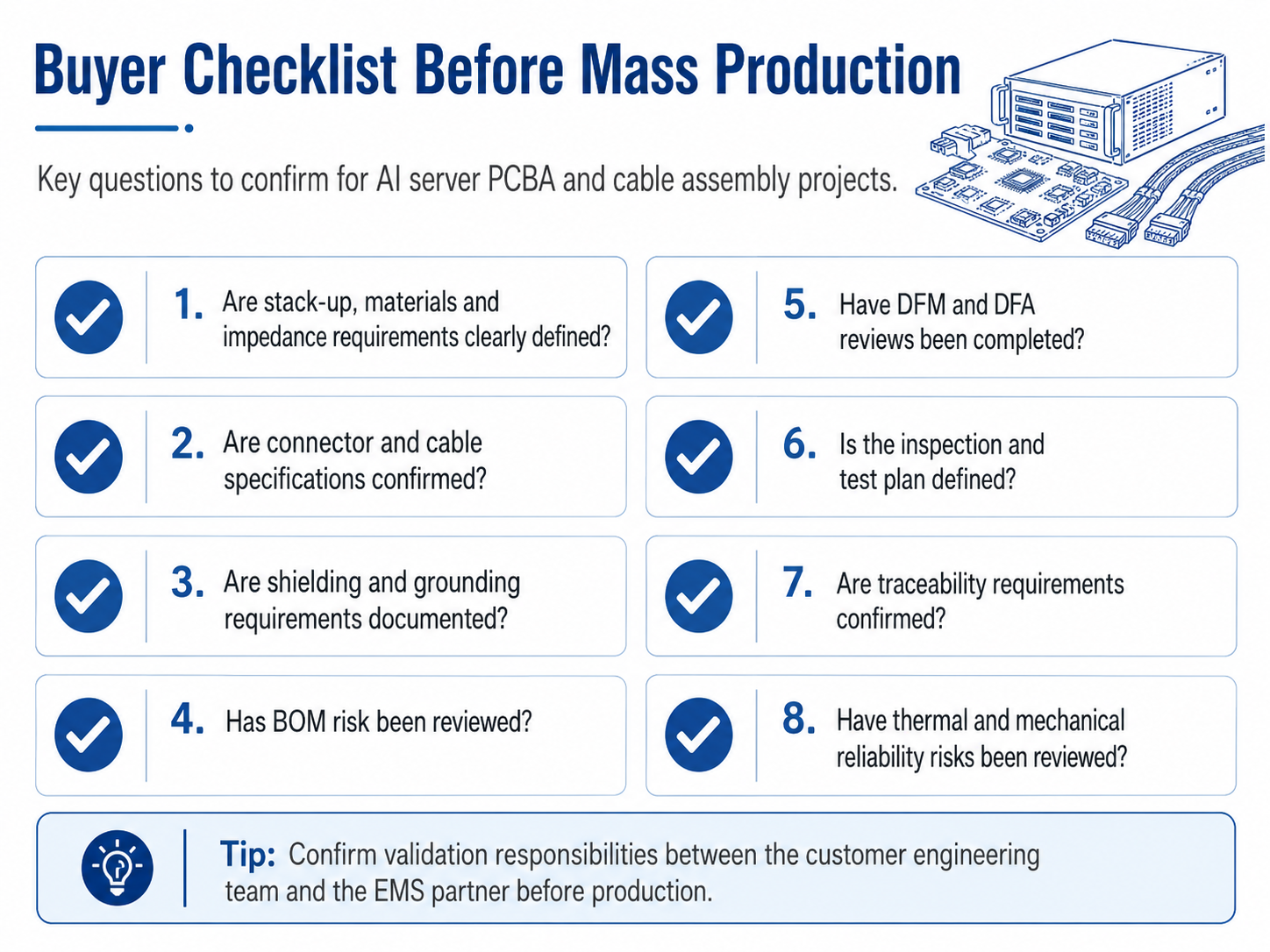
- Are the PCB stack-up, materials and impedance requirements clearly defined?
- Are high-speed connectors and cable assemblies specified correctly?
- Are shielding and grounding requirements documented?
- Has BOM risk been reviewed for shortage, EOL or second-source issues?
- Have DFM and DFA reviews been completed before production?
- Is the inspection and test plan defined?
- Are traceability requirements confirmed?
- Have thermal and mechanical reliability risks been reviewed?
For supply-chain related risk, buyers may also review: How does D-MAX handle global electronic component shortages?
Recommended DMAX Product / Service Pages
For readers evaluating high-speed PCBA, AI server interconnects, controlled-impedance PCBs or high-speed cable assembly requirements, the following DMAX product categories may be relevant depending on the project scope.
High-Density PCBA Solutions
High-Speed Cable Assembly Solutions
Related DMAX FAQ Pages for Project Planning
Conclusion
AI server platforms create more demanding PCBA and cable assembly challenges than general electronic products. High-speed signals, dense layouts, complex interconnects, thermal stress, shielding requirements and mechanical reliability all need to be reviewed carefully before mass production.
For these projects, the right EMS partner should understand how manufacturing quality affects system reliability. From NPI review and PCBA assembly to cable assembly, inspection, testing support and traceability, each step can influence the final product.
DMAX supports customers with EMS manufacturing, PCBA assembly, cable assembly, process control and quality management for industrial, IPC, AI server and high-speed computing applications. If your project involves high-speed PCBA, AI server hardware, high-speed interconnects or complex cable assembly requirements, contact DMAX to discuss your production needs, BOM status and manufacturing challenges.
Related High-Speed PCBA & Cable Assembly Topics
After reading this article, you may also be interested in the following related topics:
Frequently Asked Questions
What are the main PCBA challenges in AI server platforms?
AI server platforms often involve high-speed signals, high-density layouts, complex connectors, high power consumption and strict reliability requirements. These factors increase the importance of signal integrity, thermal control, assembly quality, cable routing and testing strategy.
Why is cable assembly important in AI server PCBA?
Cable assembly can directly affect signal quality, EMI performance and mechanical reliability. Cable length, shielding, grounding, connector termination and routing quality may all influence system stability in high-speed applications.
How does signal integrity affect AI server PCBA?
Signal integrity affects how reliably high-speed data travels through PCB traces, connectors and cable assemblies. Problems such as insertion loss, return loss, skew and crosstalk may reduce performance or create intermittent errors.
What should DMAX review during NPI for high-speed PCBA projects?
Depending on project requirements, DMAX can review production files, PCB fabrication notes, stack-up and impedance notes, connector specifications, cable assembly drawings, shielding and grounding requirements, inspection criteria and traceability needs before production.
What inspection standards may apply to AI server PCBA and cable assembly?
Depending on project requirements, PCBA quality may be reviewed according to IPC-A-610, while cable and wire harness assembly may follow IPC/WHMA-A-620. For high-reliability applications, Class 3 requirements may be specified by the customer or end application.
What should buyers check before mass production?
Buyers should review PCB materials, impedance requirements, BOM risk, cable specifications, connector quality, DFM feedback, testing requirements, traceability needs and reliability risks before moving to mass production.
How can an EMS partner help reduce production risk?
An EMS partner can help review manufacturing files, identify assembly risks, control PCBA and cable assembly quality, manage process consistency, support inspection and testing, and coordinate with the customer engineering and validation teams.
Discuss Your High-Speed PCBA or Cable Assembly Project
If your project involves AI server hardware, high-speed IPC systems, controlled-impedance PCBs, high-density PCBAs, USB AOC, active extension cables or complex cable assembly requirements, contact DMAX to discuss your BOM status, manufacturing documentation, NPI requirements and production challenges.